
Industries
Purpose-built AI systems for the industries we serve.
Services
Custom AI and software built end to end by our team.



Not sure where to start?
Talk to our teamAI-native search that understands natural language and delivers direct answers
Multi-tenant AI CRM with a per-industry module architecture — each new industry gets a tailored feature set on shared infrastructure
AI orchestration layer coordinating agent workflows across CRMs, email, and marketing tools
Try Zunkiree Search Free
See how AI search delivers direct answers instead of links. Transform your customer experience.
Start free trialReady to build with AI?
Schedule a callState of AI in Nepal 2026
The definitive guide to AI adoption across Nepali industries. Free download.
Download reportReady to build with AI?
Schedule a callAgentic as a Service (GaaS)
The billable seat is dead.
The autonomous outcome is here.
At Zunkiree Labs, we are moving the world from "Software as a Service" (tools you use) to "Agentic as a Service" (agents that work). This is not an incremental upgrade. It's a fundamental shift in how businesses operate.
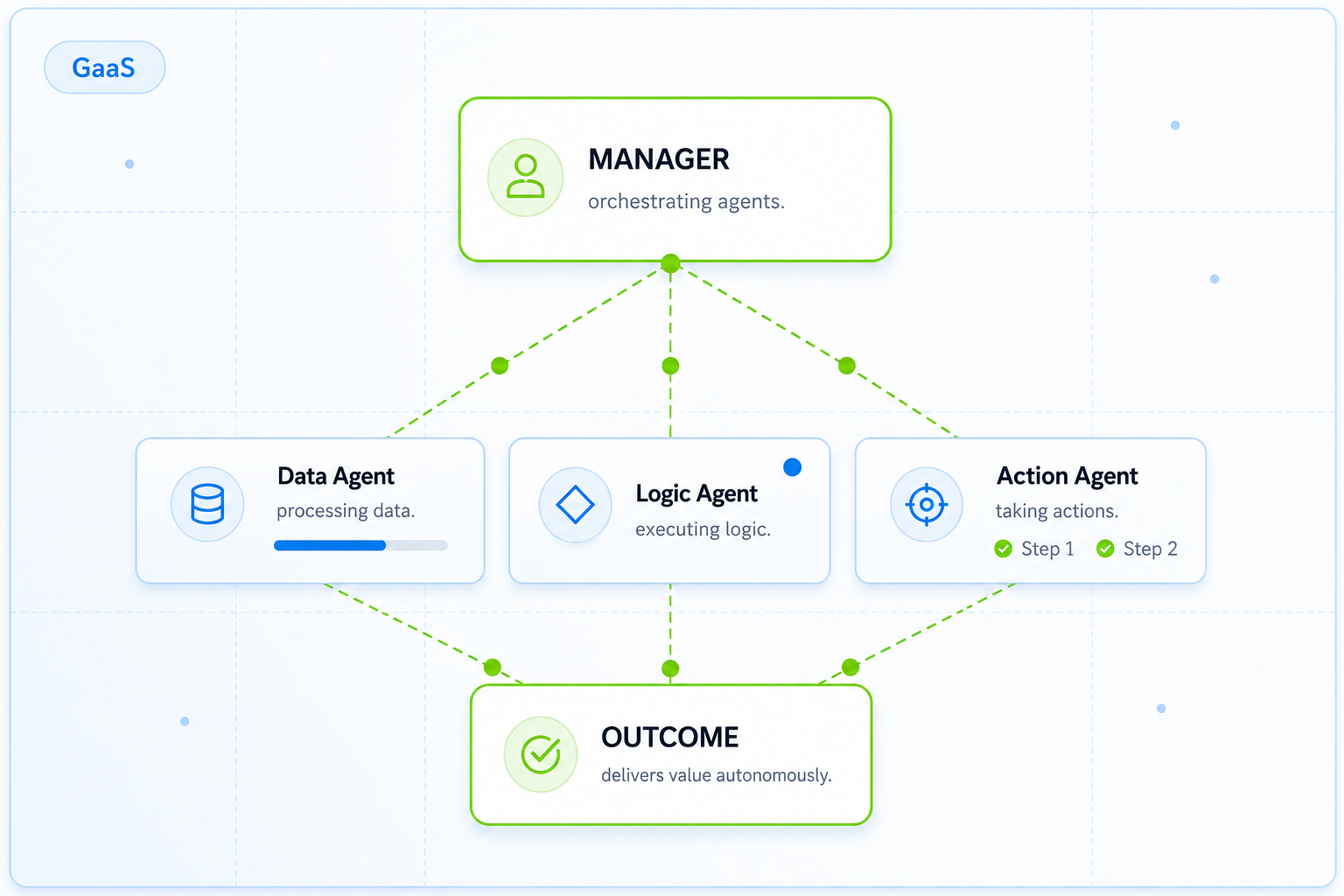
Agentic as a Service (GaaS) is a cloud delivery model where autonomous AI agents are deployed as managed services to execute business tasks independently. Unlike traditional SaaS, GaaS agents don't require human operation—they receive goals, make decisions, take actions, and deliver measurable outcomes with minimal supervision.
According to internal deployment data, GaaS implementations reduce operational costs by 60% compared to traditional automation approaches. ·Last updated: April 2026
Founder's perspective on GaaS
"GaaS represents the most significant shift in enterprise software since cloud computing. We're not selling tools anymore—we're deploying outcomes."
SaaS vs GaaS
Business Vision
| Dimension | SaaS | GaaS |
|---|---|---|
| What you get | Tools to use | Agents that work |
| Pricing model | Per seat/month | Per outcome |
| Learning curve | Weeks of training | Zero—delegate |
| Scaling | Hire more humans | Deploy more agents |
The GaaS Advantage
Zero Learning Curve
You don't "learn" GaaS software; you delegate to it. Tell the agent what you need, and it figures out how.
Outcome-Driven Pricing
Stop paying for licenses that sit idle. Pay for the task completed, the lead generated, or the code deployed.
Elastic Workforce
Scale your operations by deploying 1,000 agents in the time it takes to onboard one human employee.
Technical Infrastructure
We don't just build wrappers; we build Agentic Infrastructure. The Zunkiree GaaS model is built on four core technical pillars that enable reliable, secure, and scalable agent deployment.
- Definition
- The delivery of autonomous AI agents as a managed service
- Key Frameworks
- skills.sh, Claude Code, ReAct loops
- Core Metric
- Cost-per-Outcome (CPO)
- Deployment Model
- Managed cloud with HITL gates
The Zunkiree Agentic Stack
Our GaaS infrastructure is purpose-built for enterprise-grade autonomous operations. Each pillar addresses a critical requirement for deploying agents at scale.
Modular Agent Skills (skills.sh)
We utilize a filesystem-based Skills Architecture. Agents dynamically discover, load, and execute specialized capabilities without hardcoded dependencies.
- Auto-Discover Tools: Agents detect and install scripts for specialized tasks (Auth0 integration, CRM sync) on the fly
- Persistence: Agents maintain memory of your business logic through specialized SKILL.md definitions
- Composable: Skills combine to form complex workflows without monolithic architectures
Multi-Agent Orchestration
Our infrastructure doesn't rely on a single agent. We deploy Swarm Intelligence—coordinated teams of specialized agents working in parallel.
Orchestrator Agent
Handles high-level planning and goal decomposition
Worker Agents
Specialized instances (Security Agent, Deployment Agent, etc.)
Critic Agent
Reflection layer that validates output before production
Manager-Worker Pattern
Secure Execution Environments
GaaS requires trust. Our agents operate in hardened, isolated environments with multiple layers of security and human oversight.
Ephemeral Sandboxes
Every code execution happens in a virtualized, isolated container that's destroyed after use. No persistent access to your systems.
Human-in-the-Loop Gates
For high-risk actions (financial transactions, live deployments), agents pause for cryptographic approval from your team.
Security Guarantees
- SOC 2 Type II compliant
- End-to-end encryption
- Audit logging
- Role-based access control
- Data residency options
Claude Code & Agentic SDLC
By leveraging Claude Code, we've integrated the software development lifecycle into the service itself. Zunkiree agents can self-correct, debug, and update their own workflows based on real-world performance data.
- Continuous Learning: Agents improve from every interaction, adapting to your specific workflows
- Self-Healing: When errors occur, agents diagnose, fix, and deploy corrections automatically
- Reflection Patterns: Built-in critique loops ensure output quality before delivery
Common questions about GaaS
Agentic as a Service is a new paradigm. Here's what enterprise teams need to know.
Have more questions? Talk to usAgentic as a Service (GaaS) is a delivery model where autonomous AI agents are provided as a managed service. Unlike traditional SaaS where you use software tools, GaaS deploys intelligent agents that independently execute tasks, make decisions, and deliver outcomes on your behalf.
SaaS provides software tools that humans must learn and operate. GaaS provides autonomous agents that work for you. With SaaS, you pay per seat regardless of usage. With GaaS, you pay per outcome delivered. SaaS requires training and adoption. GaaS requires only delegation.
Cost-per-Outcome (CPO) is the core pricing metric for GaaS. Instead of paying for software licenses or user seats, you pay for completed tasks—leads generated, code deployed, documents processed, or any measurable business outcome. This aligns vendor incentives with customer success.
Yes. Zunkiree Labs GaaS infrastructure includes ephemeral sandboxed execution environments, Human-in-the-Loop (HITL) gates for high-risk actions, cryptographic handshakes for sensitive operations, and comprehensive audit logging. Agents never access production systems without explicit approval gates.
GaaS applies across industries wherever repetitive cognitive work exists: software development (code review, testing, deployment), customer service (ticket resolution, onboarding), data operations (ETL, reporting, analysis), legal (document review, contract analysis), and healthcare (scheduling, documentation, billing).
A GaaS company is a business that builds and operates autonomous AI agents and delivers them to customers as a managed service, rather than selling software licenses. Zunkiree Labs is a GaaS company: we design, deploy, and operate the agents ourselves, so customers pay for completed outcomes instead of managing infrastructure or seats.
GaaS stands for Agentic as a Service (sometimes written Agent as a Service). It follows the same '-as-a-Service' naming pattern as SaaS (Software as a Service), but delivers autonomous AI agents instead of software tools.
Yes. GaaS development means building agentic systems—goal-driven, self-correcting AI agents with tool access and orchestration—rather than traditional deterministic software. It requires expertise in LLM orchestration, agent skill design, sandboxed execution, and Human-in-the-Loop safety gates, on top of standard engineering practices.
Moving from SaaS to GaaS starts by identifying workflows your team currently completes manually inside software tools—ticket triage, lead qualification, code review—and replacing the tool-plus-human-operator model with an autonomous agent that completes the same outcome under Human-in-the-Loop oversight. Most teams pilot GaaS on one workflow before expanding it across departments.
Yes. Zunkiree Labs deploys GaaS infrastructure for clients globally, including the US, UK, India, Australia, Canada, Switzerland, and the Netherlands. Delivery isn't tied to any single location, and every engagement gets fully remote onboarding and time-zone-overlapping support.
Ready to deploy your first agent?
Move from SaaS to GaaS. Let autonomous agents handle the work while you focus on outcomes.