



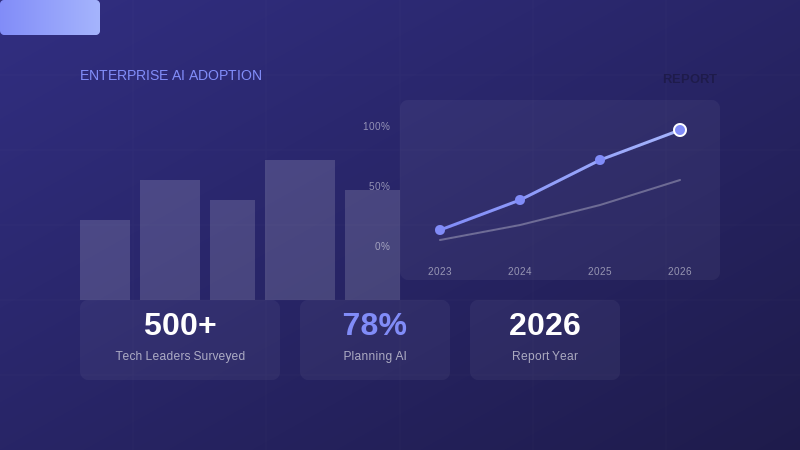
What this report covers
This annual report examines how enterprises are moving AI from pilot projects into production systems, drawing on input from technology leaders across a range of industries and company sizes.
Rather than cataloguing what the technology can do, it focuses on what organisations actually encountered: where budget went, which initiatives reached production, which stalled, and what distinguished the two.
Why adoption stalls between pilot and production
The gap between a working demonstration and a deployed system is where most enterprise AI effort is spent. A prototype needs to be convincing once; a production system needs to be correct repeatedly, monitored, owned by a team, and integrated with data that was never designed for it.
The report examines the organisational and technical factors behind that gap — data readiness, unclear ownership, and success criteria defined too loosely to evaluate — and sets out an adoption maturity model for locating where an organisation currently sits.
Using the assessment framework
The maturity model is designed to be applied, not just read. It assesses readiness across data foundations, engineering capability, governance, and the clarity of the business case, giving a view of which constraint is actually binding before budget is committed.
The report also covers budget allocation trends across AI initiatives, an analysis of the vendor landscape, and where the authors expect enterprise adoption to move next.
What you get:
- Key findings from 500+ enterprise technology leaders
- AI adoption maturity model and assessment framework
- Common pitfalls and how to avoid them
- Budget allocation trends for AI initiatives
- Vendor landscape analysis
- Predictions for 2027 and beyond
Comparison of AI adoption reports
When evaluating AI adoption reports, the key differences lie in the depth of insight, the practicality of the frameworks provided, and the focus on real-world application rather than theory.
| Feature | Alternative | This report |
|---|---|---|
| Insights from enterprise leaders | Limited number of leaders surveyed, focusing more on theoretical applications | Over 500 enterprise technology leaders surveyed for practical insights |
| Adoption maturity model | Often lacks a structured framework for assessing readiness across AI projects | Includes a maturity model to identify constraints before budget commitment |
| Focus on real-world challenges | Primarily discusses technology capabilities without addressing implementation issues | Examines common pitfalls and why AI adoption stalls in practice |
Frequently asked questions
Who is this report for?
It is written for enterprise technology leaders — CTOs, heads of engineering, and data and AI leads — who are planning or already running AI initiatives and want to compare their position against how other organisations are approaching the same decisions.
What does the adoption maturity model assess?
It assesses readiness across data foundations, engineering capability, governance, and clarity of the business case, so an organisation can identify which constraint is actually limiting progress before committing budget.
Why do so many AI projects stall after the pilot stage?
A prototype only has to work once, while a production system has to be correct repeatedly, monitored, owned by a team, and integrated with data that was never designed for it. The report examines the data-readiness, ownership, and success-criteria issues behind that gap.
Does the report cover budget and vendor selection?
Yes. It includes budget allocation trends across AI initiatives and an analysis of the vendor landscape, alongside the maturity model and the authors’ outlook for where enterprise adoption moves next.