



How keyword search actually works
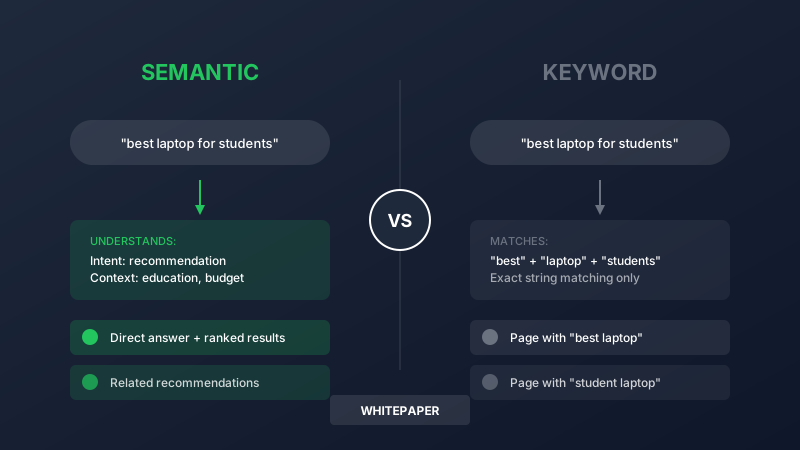
Keyword search matches the literal terms in a query against an inverted index — a map from each term to the documents containing it. Ranking functions such as BM25 then score results on term frequency, how rare the term is across the collection, and document length.
This approach is fast, cheap to run, and completely transparent: you can always explain why a document ranked where it did. Its limitation is equally clear. A query for “reduce support tickets” will not match a document that only ever says “lower helpdesk volume”, because the two share no terms.
How semantic search differs
Semantic search represents both the query and the documents as vectors — dense numeric embeddings produced by a language model — and retrieves by proximity in that vector space rather than by shared words. Documents about lowering helpdesk volume sit near queries about reducing support tickets because the model has learned they mean similar things.
The trade-off is real. Embeddings must be generated and stored, similarity search needs a vector index, and results are harder to explain than a term match. Semantic retrieval also has no inherent notion of exactness, which matters when a user searches for a specific part number or error code.
Choosing between them — and why most systems use both
The practical answer for most production systems is hybrid retrieval: run both, then combine the rankings. Keyword search preserves exact matching for identifiers, names, and codes, while semantic search covers paraphrase and intent. Fusion methods such as reciprocal rank fusion merge the two result sets without either dominating.
This whitepaper sets out the architecture for each approach, how to benchmark them against your own corpus rather than a public dataset, and what a staged migration from keyword-only to hybrid retrieval looks like in an existing product.
What you get:
- Technical architecture comparison
- Performance benchmarks
- Use case recommendations
- Migration strategies