



Embeddings and vector spaces
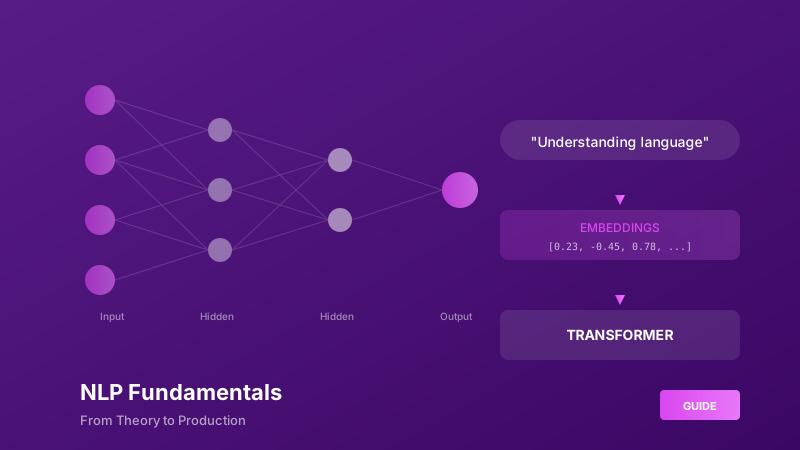
Modern NLP begins with representation. An embedding maps a piece of text — a word, sentence, or document — to a vector of numbers positioned so that texts with similar meaning sit close together. Distance in that space becomes a usable measure of semantic similarity.
This single idea underpins semantic search, clustering, classification, and retrieval-augmented generation. The guide covers how embeddings are produced, how to choose dimensionality and a distance metric, and the practical question of when a general-purpose embedding model is sufficient versus when a domain-specific one earns its cost.
The transformer architecture
Transformers process an entire sequence at once and use self-attention to let every token weigh its relationship to every other token. That parallelism, and the ability to model long-range dependencies directly, is what enabled the current generation of language models.
The guide explains attention, positional encoding, and the encoder/decoder distinction in practical terms — enough to reason about why a model behaves as it does and what its context window costs you, without requiring a research background.
Fine-tuning and production deployment
Most enterprise NLP work starts from a pre-trained model rather than training from scratch. The guide covers when full fine-tuning is warranted, when parameter-efficient methods are the better choice, and when careful prompting and retrieval remove the need to fine-tune at all.
It closes on the operational concerns that decide whether an NLP system survives contact with production: latency and throughput budgets, inference cost, model versioning, evaluation that catches regressions, and monitoring for drift once real traffic arrives.
What you get:
- Understanding embeddings and vector spaces
- Transformer architecture explained
- Fine-tuning pre-trained models
- Production deployment considerations